The Best Time for a Teide Quad Tour
Morning or sunset, and which month. How the cloud sea, the calima, winter snow and a 10–15°C drop change what you get from a Teide quad ride.
Tenerife’s coast is famously flat in its seasons — the difference between February and August at sea level is only a few degrees. Two thousand metres up, none of that holds. The caldera has its own weather, its own light, and a set of conditions that make one departure slot dramatically better than another depending on what you want from the ride. Here is how to pick.
Check Availability
Morning or sunset — the real difference
Both slots go to the same mountain. They give you completely different days.
Morning departures put clear, high-angle light on the lava. The caldera’s colours — the rust reds, the ochres, the black flows — read properly in daylight and go flat in silhouette. Mornings are also the quieter half: the coach excursions arrive from mid-morning onwards, and one operator times its Teide route deliberately early to reach the viewpoints ahead of them. You descend warm.
Sunset departures trade all of that for one thing that is genuinely hard to beat. Above the tree line you are usually looking down on the cloud layer rather than up at it, and when the sun drops into it the whole sheet turns orange beneath you while the cone stays lit above. There is a reason the 19:00 slots sell out first.
The Cost of a Sunset Ride
The cost is the descent. You lose 2,000 metres in the dark with wind on an open machine, and the temperature at that altitude falls quickly after sunset — clear nights on Teide can approach freezing even in summer. The Chío tour is the only sunset option that hands out a thermal jacket and gloves, which is worth the price difference if you feel the cold. The $70 sunset ride goes to the same place at the same hour with a helmet and your own layers.
Sunset itself moves a long way through the year on Tenerife — the earliest is around 18:10 at the start of December and the latest just after 21:00 in early July — so a “sunset tour” in January finishes before dinner and in July finishes close to eleven at night once you are back at your hotel.
The cloud sea, and why it is a northern thing
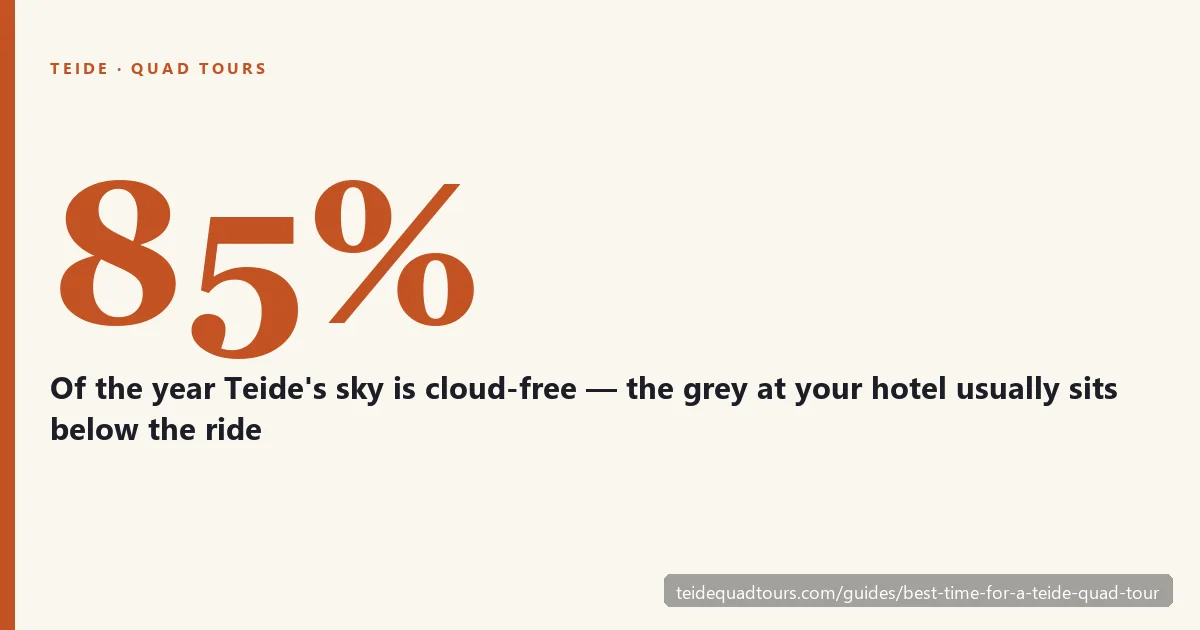
The sea of clouds is not weather so much as geography. Trade winds push moist Atlantic air against the north of the island, it rises, and it condenses into a layer that sits roughly between 800 and 1,600 metres. Above that, the air is dry and the sky is usually clear — Teide is cloud-free about 85% of the year, which is why the observatories are up there.
For a quad rider this means two things. First, a grey morning at your hotel is not a reason to cancel; the cloud you are looking at is very likely below the level you are riding to. Second, the effect is strongest on the north side, so a northern departure like the Puerto de la Cruz tour rides up through the cloud layer and out the top of it, which is a memorable few minutes in itself.
Month by month
| Period | What the mountain is doing | Verdict for a quad tour |
|---|---|---|
| December–February | Coldest and the only real snow window; access roads close for ice several times most winters | Spectacular when it is clear, but check the forecast and keep your cancellation window |
| March–May | Warming, long clear spells, caldera scrub in flower from about April | The sweet spot — comfortable riding, colour on the ground, no peak-season crowds |
| June–August | Warmest and busiest; nights still cold at altitude; sunset slots run late | Best for sunset rides, worst for company at the viewpoints |
| September–November | Quiet, stable, still warm; light softening through autumn | The other sweet spot, and the easiest time to get the slot you want |
Two things can happen in any month. Calima — Saharan dust blown across on an easterly — raises temperatures noticeably and turns the air hazy, which flattens the long views for two to four days until it clears. And snow closes the mountain roads in winter: the TF-21, TF-24 and TF-38 have all been shut precautionarily for ice in recent seasons, and when that happens tours are cancelled rather than re-routed.
What to wear, whichever slot you pick
The single most repeated mistake on this mountain is dressing for the beach you left. The caldera runs roughly 10 to 15°C below the coast before you add the wind chill of an open quad at speed, and that gap is largest in exactly the conditions people underestimate — a hot, still afternoon in Los Cristianos.
- A fleece or a mid-layer, plus something windproof over it
- Long trousers, not shorts
- Closed-toe shoes, which are mandatory on every tour anyway
- Sunglasses — the light at altitude is fierce even when the air is cold
- Sunscreen, for the same reason
Two of the five tours provide a thermal jacket and gloves. The rest give you a helmet and expect you to have thought about it. Our full guide to what to wear for quad biking on Teide has a packing list for day and sunset rides.
Frequently Asked Questions
Is a sunset quad tour on Teide worth it?
If you want the best light and a good chance of watching the sun set into a cloud sea below you, yes — it is the most photographed hour on the mountain. If you want to see the caldera’s colours clearly, take a morning slot instead; after sunset the lava reads as silhouette. The one thing to plan for is the descent, which is cold.
What is the best month for a Teide quad tour?
April, May, September and October. Comfortable riding temperatures, stable clear weather, no winter road closures, and fewer people at the viewpoints than in July and August. April and May add the flowering caldera scrub.
Do quad tours run in winter?
Yes, all year, but winter is the one season when a booking can be cancelled by the mountain rather than by you. Snow and ice close the access roads several times most winters. Every tour on this site has free cancellation up to 24 hours before, so check the forecast the evening before and rebook if it looks marginal.
What if it is cloudy at my hotel?
Usually irrelevant. The cloud layer sits between about 800 and 1,600 metres on the north-facing slopes, and the tours climb above it. A grey coast very often means a clear caldera with a cloud sea underneath — which is the best-case scenario, not the worst.
How cold does it actually get up there?
Expect roughly 10 to 15°C below the coastal temperature, plus wind chill. Clear nights in the park approach freezing even in summer, which is why the sunset departures matter more for clothing than the daytime ones.
What is calima and will it ruin my tour?
Calima is Saharan dust carried over on an easterly wind. It pushes the temperature up by several degrees and hazes the air, which flattens the long views across the island. Tours still run — the road and the landscape immediately around you are unaffected — but the horizon disappears. It typically clears within two to four days.
Ready to Book?
Check live availability and pick your slot on the homepage, or compare all five routes in the tour comparison guide.
Ride Into the Caldera
Three hours on the mountain roads into the caldera, with the highest peak in Spain in front of you. Thermal jacket, gloves and full-face helmet provided, transfer from the southern resorts on request, free cancellation up to 24 hours before.
Check Availability & Book